
Decision Craft: how to decide

Updated: May 27

I've always found general conversations about "Decision Making" a little flat and empty. And that might be because there are often a few bad assumptions baked in:
There is one kind of thing called "a decision" - For me we can speak more clearly when we aren't talking about the noun but the verb - about the act of deciding. And then our focus moves from the thing called a decision (as if there is just one type) to the world we are trying to impact by deciding. This has us see that there are many different contexts and reasons why we would need to decide on something - and so decisions need to be approached differently - depending on what we are trying to get done.
This thing called a decision can be "made" - and mostly this making is assumed to be at scale - so close to decision manufacturing - something that can be repeatably done across all contexts.
Both of these ideas lead organisations towards a single scaleable "decision making approach" - like RAPID (providing a process) or RACI/DACI (assigning roles). I've seen both of these approaches be helpful - but i have never seen them not also feel cumbersome. Because they assume that all "decisions" need to "get made" the same way. So RACI is often way too much for small decisions (we dont need all these roles! we are spending time on frameworks not on deciding well!) and way too little for big decisions (we need additional roles or additional processes to make good decisions).
I'm proposing rather than abstracting about decision making (in this manufacturing paradigm) we should consider our decision craft. Where we start with the situation we are faced with (including all the context) and what we are trying to do. And take an approach to deciding that fits the situation. This is a call to be less snappy in pursuit of being more thoughtful - and not tying ourselves up in bureaucratic knots.
To help learn the craft i'm proposing two aspects worth considering:
Our ways of deciding
The dynamics of the decision
Five ways of deciding
Here are five ways of deciding.
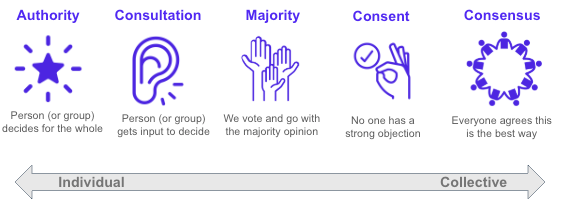
I'm suggesting that they are all good in their place and bad out of place. I'm suggesting that for any given situation there will be one or two ways of deciding that will be wise and one or two that will be unwise. Your work as a craftsperson is to make the call and see how it goes. Let's look at them in turn.
Authority - a person (or a group) decides for the whole.
Advantages: fastest and clean (if scope clear); honours expertise or stake; authority exists in the world and has often been well earned.
Challenges: requires trust; can burn trust when stakes are high; may not get buy in; damaging if unclear scope; sociopaths exist.
Key Q: who has the authority? how is authority given? what is the scope/limits?
Consultation - a process of gathering input for a person (or a group) to decide.
Advantages: listens to more/all voices; still values authority.
Challenges: can be slow; can feel fake/performative (eg: if you just went with your original opinion).
Key Q: same questions for authority but also - what is the process? How is input weighted?
Majority opinion - we take a vote and we go with the majority.
Advantages: clean and quick; we can vary the vote threshold to move forwards in different contexts (eg a yes in this context needs 70% agreement)
Challenges: creates winners and losers; ignores nuances like weight of opinion (how much you prefer one over the other) or stake in decision (how different decisions might mean more for some people); may reinforce status quo or create backlash.
Key Q: are we adequately informed? Who has more at stake? What might be the impact on minority voices?
Consent - no objections - being willing to go along with a decision that is “good enough for now and safe enough to try”.
Advantages: pragmatic; lets us move without 100% agreement; listens to views that matter; respects stake.
Challenges: can rush things or brush debate under carpet; ‘consent creep’ (eg agreeing to an experiment but then it gains momentum that is harder to resist)
Key Q: where can we tolerate “good enough” decisions? How will we revisit/monitor?
Consensus - full agreement.
Advantages: buy in! We all agree!
Challenges: time and energy taken; can feel like an energetic drag on a group (are we still taking about this?); inappropriate/impractical for many decisions; creates pressure to artificially "agree" rather than honest exploration of differences; gives a lot of airtime to dogmatism/nitpicking; round and round in circles.
Key Q: what is it worth investing in to get true consensus? How can we make the time that this needs?
These are general ways of deciding. But there are also systems/methodologies/schools that add particular forms to these ways - and provide frameworks or heuristics for when and how we should use each. These have all added to my decision craft: design thinking, agile, holocracy, sociocracy, deep democracy, etc etc. For example I'm studying Lewis Deep Democracy and it has a lot of elegance as an approach - mostly mixing voting with consent but with space for authority and ways of getting to consensus. Just to illustrate the value in specific forms: LDD assumes that we want to move forwards together - to make this decision and remain in a good relationship. So when a decision has been (in any way - in a vote or by authority) you always ask this question:
What do you need to come along?
"You lost the vote and this is the decision you didn't prefer - but we want to move forward together - so what do you need to come along?" This opens up the possibility for shifting in response to what they reply. There are many other good forms built into different systems.
The dynamics of the decision
As well as ways to decide, we also need to consider the dynamics that any decision entails. This is building on my core work with The Let's Go Model. I'm not suggesting all five dynamics will need your attention for every decision - we aren't manufacturing decisions - but that good decision craft means considering which dynamics are important for the situation at hand.

BELIEF: How does this decision align with our purpose, values, and strategic goals?
Work to do: Analyse context and alignment with strategy
To move from decision to action: How do we communicate the decision and motivate people behind it?
Decision making sins: Short termism and Silo thinking
STRUCTURE: Who has the authority to decide and who do we escalate to if we need help?
Work to do: Understand the organisational accountabilities (you might do a RACI/DACI)
To move from decision to action: What processes or resources need to be in place to implement this decision?
Decision making sins: Passing the buck and Bypassing legitimate authority
INVOLVEMENT: What input do we need and whose perspectives do we need to listen to?
Work to do: Map out stakeholders and expertise
To move from decision to action: Who do we need to bring along with the decision and what do they need?
Decision making sins: Groupthink and Ignoring perspectives
PROGRESS: What is the right balance of ambition vs safety and agility vs confidence?
Work to do: Scenario planning and risk/impact assessment
To move from decision to action: How do we measure and review the success of this decision?
Decision making sins: Refusing to let go and Bias
CARE: How will this decision impact our relationships and team dynamics?
Work to do: Evaluate impact on culture, wellbeing, and partnerships
To move from decision to action: How do we acknowledge contributions and build togetherness going forward?
Decision making sins: Playing politics and Self-interest
PRESENCE: What ethical considerations and leadership preferences shape this decision?
Work to do: Open review of ethical implications and your own leadership preferences (what you care about! the world you want to create!)
To move from decision to action: What can we learn from this decision, and how do we anticipate challenges?
Decision making sins: Ignorance and Deception
Improving your decision craft takes time
And it's not about decisions as much as about knowing your situation and having options.
Two questions to help you build your craft:
What is the right way of deciding? Authority, Consultation, Majority, Consent, Consensus
What is the dynamics that will impact the decision? Belief, Structure, Involvement, Progress, Care - and your own Presence
What did i miss? What else supports Decision Craft?
At Let's Go we are concerned with reinvigorating organisations for complex times - this looks like supporting clients with organisational strategy, cultural evolution, strengthening teams and collaboration and leadership skills. We bring powerful frameworks and scaleable tools to bear on particular situations.


Comments